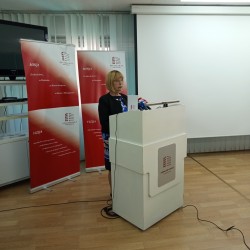
Professionals recognize the importance of modern protection standards, but staff shortages, limited time, lack of standardized procedures, and insufficient institutional cooperation mechanisms continue to constrain an effective systemic response.
In order to improve and strengthen the response to gender-based violence in Sarajevo Canton, a team from the Department of Social Work at the Faculty of Political Sciences of the University of Sarajevo conducted research aimed at analyzing the existing response of social services to gender-based violence and identifying priority areas for strengthening professional capacities, developing educational and training materials for practitioners, improving risk assessment and safety planning procedures, and strengthening interinstitutional cooperation.
The research included a survey of professionals employed in social protection services: social workers, psychologists, lawyers, and pedagogues involved in working with of violence. To ensure the relevance of the findings, the research included professionals with more than ten years of work experience.
The research team has prepared the preliminary results of the quantitative component of the research. The final report, which will also include the findings from focus groups, as well as comprehensive recommendations for improving the system of support for victims of gender-based violence in Sarajevo Canton, will be presented at a later stage.
What the Preliminary Findings Show
The preliminary findings of the research point to significant professional potential within the social protection system, but also to structural barriers that limit its effectiveness. Most professionals recognize the importance of risk assessment and the application of trauma-informed approaches, indicating that contemporary professional standards have been adopted. However, standardized risk assessment tools are still not sufficiently integrated into everyday practice: nearly half of respondents stated that they were not familiar with or did not use such tools. At the same time, 63.4% of respondents identified limited institutional capacities, while 68.3% cited a lack of time and professional staff as key challenges.
The findings also highlight intersectoral cooperation as one of the key elements of effective victim protection. However, while system actors recognize its importance, cooperation in practice still relies heavily on individual commitment, personal contacts, and informal professional networks. Rather than being supported by stable and clearly defined institutional coordination mechanisms, collaboration often depends on relationships between individual professionals. This represents one of the key systemic gaps identified by the research, as it can affect the consistency and continuity of support provided to victims. In addition, almost half of organizational units do not have a unified case-recording system, further limiting the ability to systematically monitor interventions, share relevant information, and ensure continuity of support.
Organizational and Resource Constraints
A particularly important finding concerns victims’ participation in decision-making processes. Although contemporary protection standards emphasize victims’ right to actively participate in planning their own safety and support, only 19.5% of respondents reported full participation of service users in these processes. This finding points to significant room for strengthening empowering approaches that position victims as active participants rather than merely recipients of services.
When it comes to protection mechanisms, professionals express confidence in existing measures, including emergency and protective measures and safety plans. Nevertheless, their effectiveness is generally assessed as only partial. The findings suggest that the main barriers may not lie in the protection mechanisms themselves, but rather in the organizational and resource constraints affecting their consistent and timely implementation
Key Message of the Research
The preliminary findings indicate a system that is more developed in normative terms than it is operationally functional. Professional standards and knowledge among practitioners have largely been adopted, but institutions have yet to develop the staffing, procedural, and resource conditions necessary for their consistent implementation in everyday practice. In other words, the key challenge is no longer determining what needs to be done, but creating the conditions that will enable existing standards to be implemented in a sustainable and systematic manner.is activity was implemented within the project “From Cooperation to Action: Improving the System of Care for Victims of Gender-Based Violence in Sarajevo – Phase 1,” implemented by the Foundation of Local Democracy in partnership with the Solidaritat Foundation of the University of Barcelona, the University of Sarajevo, the Ministry of Labour, Social Policy, Displaced Persons and Refugees of Sarajevo Canton, and the Ministry for Science, Higher Education and Youth of Sarajevo Canton, with financial support from the City of Barcelona.